 Free Canada-Wide Shipping on Orders $300+
 Proudly Canadian
 Third-Party Lab Tested - 99% Purity Standards

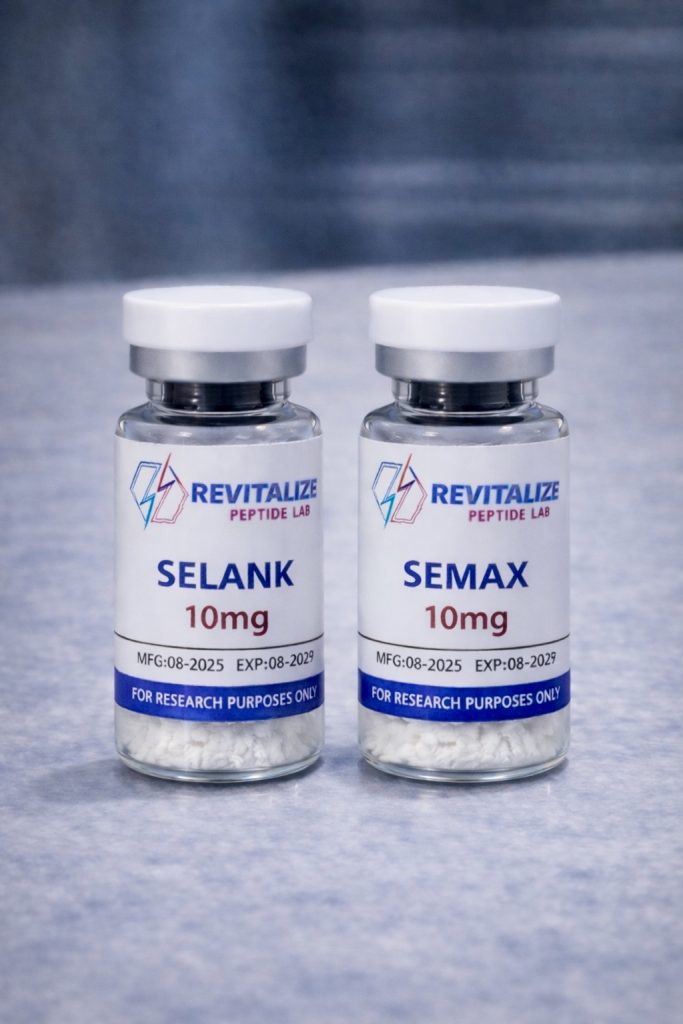
Selank & Semax: What Research Says About Their Neurobiological Effects
Synthetic regulatory peptides such as Selank and Semax have been the subject of multiple preclinical and clinical research studies over the past two decades. Although these peptides are structurally distinct, both are derived from biologically active sequences related to larger endogenous molecules and have been investigated for their effects on neural systems, cognition, and stress-related processes in experimental settings.
In research conducted by Syunyakov et al. (2012), the peptide Selank was examined in patients diagnosed with generalized anxiety disorder (GAD). The researchers reported that intranasal administration of Selank produced significant reductions in clinical anxiety scores, though time to response varied between individuals. Approximately 40% of participants experienced rapid symptom reduction within the first few days, while the remaining 60% showed more gradual improvements over two weeks. Syunyakov and colleagues also observed that rapid responders exhibited distinct electroencephalographic (EEG) patterns, including increased beta-rhythm activity following a single Selank dose (Syunyakov et al., 2012). These findings suggest that Selank can modulate neural activity patterns associated with anxiety regulation, though the underlying mechanisms remain under investigation.
Other research points to neurochemical modulation as a potential mechanism of action for Selank. Work summarized in the scientific literature indicates that Selank may influence major neurotransmitter systems, including those involving γ-aminobutyric acid (GABA), dopamine, and serotonin, which are critical regulators of mood and cognitive processes (Eremin et al., 2005; Dolotov et al., 2006). While these observations derive mainly from animal studies, they contribute to a broader understanding of how regulatory peptides interact with central nervous system signaling systems.
Semax, another synthetic peptide derivative, has been investigated for its effects on gene expression and neurotrophin regulation in preclinical models. In a genome-wide transcriptional analysis conducted by Medvedeva et al. (2014), Semax was administered to rats following induced cerebral ischemia. The researchers reported that Semax altered the expression of dozens of genes associated with immune response, vascular development, and neurotransmission in ischemic brain tissue, suggesting that Semax can broadly influence molecular pathways that are disrupted during ischemic injury. These transcriptional effects on immune and vascular genes align with earlier observations in which Semax was found to increase levels of brain-derived neurotrophic factor (BDNF) in specific brain regions, which is a protein involved in neuronal survival and plasticity (Dolotov et al., 2006).
In animal experiments summarized by multiple research groups, Semax has also been shown to interact with neurochemical systems related to dopamine and serotonin signaling, both of which impact cognitive and adaptive responses in rodent models (Eremin et al., 2005). Such findings support the idea that Semax’s biological activity involves modulation of neurotransmitter pathways and gene regulatory networks that could underlie its neuroprotective and regulatory properties.
Collectively, the research on Selank and Semax highlights that these peptides can influence neural systems through multiple mechanisms, including modulation of neurotransmission, changes in gene expression, and interactions with neurotrophic factors. Across clinical and preclinical research, both peptides have been shown to produce measurable changes in neural activity, cognitive performance tests, and molecular signaling profiles in experimental settings. However, it is important to emphasize that most of this evidence comes from controlled research environments, and descriptions of these findings are intended for educational and informational purposes only.
Future research continues to explore how these peptides function at the molecular level, how they influence complex neural systems, and what additional roles regulatory peptides may play in neuroscience research. As the scientific literature expands, more detailed mechanistic insights are likely to emerge, contributing to a richer understanding of peptide-mediated modulation in the brain.
Important Notice
This content is provided for educational and informational purposes only. The research discussed relates exclusively to laboratory and scientific investigation. No claims are made regarding biological activity, therapeutic use, or clinical outcomes. Peptides referenced are not intended for human or veterinary use.
Sources
Dolotov O. V. et al. (2006). Semax, an analogue of adrenocorticotropic hormone fragment, modulates neurotrophin expression and neurotransmitter systems. Journal of Neurochemistry.
Eremin K. O. et al. (2005). Effects of Selank on dopaminergic and serotonergic systems in rodent models. Neurochemical Research.
Medvedeva E. V. et al. (2014). Semax influences expression of immune and vascular system genes following cerebral ischemia in rats: a genome-wide transcriptional analysis. BMC Genomics.
Syunyakov T. et al. (2012). Rapid and slow response patterns during Selank treatment in generalized anxiety disorder patients. European Psychiatry.