 Free Canada-Wide Shipping on Orders $300+
 Proudly Canadian
 Third-Party Lab Tested - 99% Purity Standards

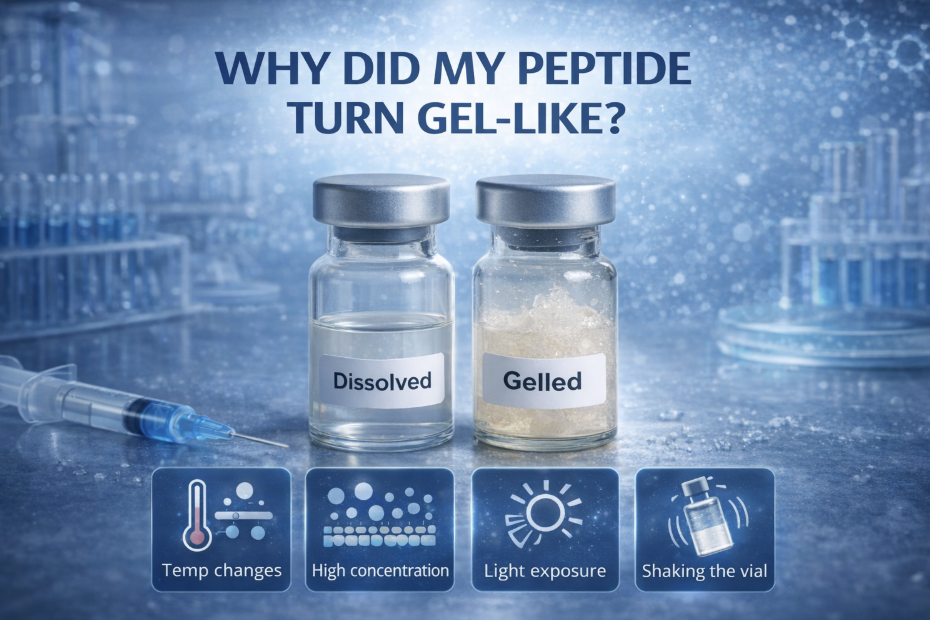
Why Did My Peptide Turn Cloudy or Gel-Like?
If you’ve ever noticed a peptide solution looking cloudy, thicker than usual, or slightly gel-like, you’re not alone. This can happen from time to time in research settings, and in most cases it’s related to storage or handling conditions rather than the peptide itself. Understanding why these changes occur — and when they matter — can help researchers maintain more consistent conditions and avoid unnecessary confusion.
What’s actually happening
Peptides are delicate molecules. When conditions aren’t ideal, individual peptide molecules can begin interacting and sticking to one another. As more of these interactions occur, the solution may lose its clear appearance and start to look cloudy, viscous, or gel-like. This process is commonly referred to as aggregation, and it’s one of the most frequent reasons a peptide solution changes in appearance.
What this is not
Cloudiness or thickening does not automatically mean a peptide is contaminated or low quality. In many cases, these changes simply reflect stress from temperature shifts, handling, concentration, or time rather than an issue with the peptide itself.
Common reasons peptides thicken
1. Temperature changes – Repeatedly moving a vial in and out of the fridge can stress the peptide structure. Over time, these temperature swings make it easier for molecules to clump together.
2. High concentration – When a large amount of peptide is dissolved in a small volume, the molecules interact more frequently, which can increase the likelihood of aggregation.
3. Shaking the vial – Shaking creates unnecessary movement and stress on the solution. Gentle swirling is generally preferred if mixing is needed.
4. Expired or improperly stored bacteriostatic (BAC) water – Once opened, BAC water is typically considered sterile for a limited period of time, often around 30 days when stored in the refrigerator. Using BAC water beyond this window may affect sterility and solution stability, which can lead to cloudiness or make a peptide appear compromised.
5. Light exposure – Prolonged exposure to bright light may gradually affect peptide stability over time.
6. Time – Even with proper storage and handling, reconstituted peptide solutions are not indefinitely stable. The longer they sit, the more likely changes in appearance can occur.
Can a cloudy peptide be fixed?
If a peptide solution is only mildly cloudy, allowing it to rest at a stable temperature and gently swirling it may help improve clarity in some cases. When a solution was prepared at a higher concentration, some researchers also find that slightly diluting it with additional bacteriostatic water can reduce visible cloudiness. These steps are generally limited to minor appearance changes and are not meant to correct more significant instability.
If cloudiness persists after resting, or if the solution does not improve with gentle swirling or the addition of bacteriostatic water, this often means the peptide molecules have aggregated in a way that is unlikely to reverse. Solutions that become thick, stringy, or gel-like typically indicate more extensive structural changes. Visible particles or clumps that do not disperse with gentle movement are another sign that the solution is no longer uniform.
Over time, even carefully handled peptides can continue to change in appearance. Reconstituted solutions are not indefinitely stable, and the longer they sit, the more likely these changes are to occur. When there is uncertainty about stability, many researchers choose to discard the solution and prepare a fresh one. Working with a peptide that looks or behaves differently than expected can introduce variability, whereas starting with a clear, stable solution helps support more predictable research conditions.
Importantly, needing to discard a peptide due to appearance changes does not mean it was poor quality to begin with. In most cases, these changes are linked to storage conditions, handling, concentration, or time rather than the peptide itself.
Why stability matters
Maintaining peptide stability helps support more consistent behavior in research settings. Careful preparation, proper storage, and gentle handling reduce unnecessary variables and help preserve solution clarity over time.